

All good things must come to an end and, sadly, that includes our Walking with Paul Tour. Happy to say we went out with a bang—literally. I’ll get to that.
Let’s begin with our stop in Patmos, where the Apostle John received a revelation from God which resulted in the Book of Revelation, the last book of the New Testament. John was exiled to the Aegean island of Patmos by Roman authorities for preaching the Christian faith and his testimony of Jesus Christ. Though isolated, he received profound apocalyptic visions during this time, ultimately resulting in the writing of the Book of Revelation.

Roman officials often banished political and religious dissidents to isolated islands. John was sent to Patmos to remove him from his leadership role over the churches in Asia Minor. Some scholars date the exile to around 95-96 AD during the reign of Emperor Domitian, while others propose an earlier date in the 60s AD under the rule of Nero. Estimates for the duration of his exile range from a few months to around 18 months, concluding with his release following Domitian’s death.
According to Revelation 1:9-11, John was “in the Spirit on the Lord’s day” when he heard a voice and was instructed to write down the visions he was shown. His visions included the glorified form of Jesus Christ, messages addressed to the seven churches of Asia Minor, prophetic glimpses of the end of the world, Christ’s final victory over evil empires, and the establishment of a new heaven and new earth.
Our tour guide took us by bus up a mountain to the Holy Cave of the Apocalypse, the place where John saw the visions and heard the voices, according to tradition. Our guide mentioned specific spots inside the cave where, also according to tradition, John rested, gripped an opening to stand up, and placed his scroll to record the visions he received. There are three narrow openings in the rock which, guess what, according to tradition, allowed God’s voice to get through to John.

Following the end of the exile, church history indicates John was released and returned to the city of Ephesus, where he continued to lead the regional churches until his death at an advanced age.
After the cave tour, we rode higher up the mountain and then hiked to the summit for a tour of the Monastery of Saint John the Theologian, a fortress-like structure built in 1088 AD. It contains a museum with numerous ancient Christian manuscripts and historical artifacts.
While the tour of the cave was interesting, I think it’s important to distinguish between facts/truth and tradition, which may or may not be true. What we know is that John heard a voice and saw visions while exiled on the island of Patmos and wrote it all down in the Book of Revelation. Those are facts. However, we don’t know exactly when that happened, where on the island it happened, or how long John was on the island.
That leads to my only complaint of Bible land tours, whether here in Greece or in Israel. It is very common for the locals to go beyond what is in the Bible and state, with some certainty, that a particular miracle or a specific event happened at an exact spot. They’ll say this is the exact spot where Jesus was born, where He was baptized, where He multiplied fish, where He was crucified and buried, and where He ascended to Heaven, among other claims. As for the Old Testament, they’ll claim to know the exact location of Moses’ burning bush and the Garden of Eden. Then they often build a church or monastery on top of that site, conduct tours for a price, and offer a souvenir stand for good measure. While I believe all of those events happened, I don’t believe we know the exact location. So those who claim otherwise—“according to tradition”—detract from my experience. And, oh by the way, the God who created the Heavens and the Earth didn’t need a crack in the cave rock for his voice to get through to John. To be clear, my complaint is against the locals who make such claims and monetize biblical events, not the tour companies who work tirelessly to bring people to these special places.
To sum up my Patmos experience, it’s a beautiful island with 163 miles of coastline—perfect for swimming, diving, and snorkeling. I’m thankful John received a vision there and the Book of Revelation resulted. If the cave tour helps people relate to or imagine these events more clearly, good for them. But serious students of the Bible should strive to separate known facts from tradition.
Our next stop was Crete, the largest of the approximately 6,000 Greek islands, with a population of about 650,000. Although there is evidence of settlements on Crete many thousands of years ago, the first recorded civilization is that of the Minoans (circa 3000 BC).
On a journey to Rome—as a prisoner—Paul stopped at Crete as the ship made its way along the southern coastline (Acts 27:7, 12, 13, 21). Paul also spoke about leaving Titus in Crete to help the churches and appoint elders in every city (Titus 1:5). The first Christians on Crete may have been converted on the Day of Pentecost as some were present for Peter’s preaching (Acts 2:11)
Crete, the first European civilization and the legendary home of the Minotaur (half bull and half man) is full of fascinating archaeological sites, including six recognized by the UNESCO World Heritage Committee because of their value and being home to Minoan palace centers. Our guided excursion took us to one of those sites—the Minoan palace at Knossos.
The Palace of Knossos is the largest and most famous archaeological site of the Minoan civilization and is widely regarded as Europe’s oldest city. In fact, while the tour of the palace grounds was fascinating, what struck me the most was just how old the place is. The people here lived 3000 before Jesus was born.

The complex’s massive size, intricate, maze-like layout, and recurring bull motifs are believed to have inspired the famous Greek mythological legends of King Minos, Daedalus and Icarus, and the Minotaur. Our word “labyrinth” comes from the Ancient Greek labyrinthos (λᾰβύρῐνθος), which was used to describe a building with intricate passages. Etymologists trace this back even further to the pre-Greek Minoan civilization. In short, we were kind of walking through the first labyrinth. The palace was highly advanced for its time, featuring a complex plumbing and drainage system, light wells, and multi-story construction.

The best stop on the Palace of Knossos tour was the Throne Room, which contains a remarkably preserved gypsum (alabaster) chair recognized as the oldest throne in Europe. Many walls are adorned with stunning, brightly colored reconstructions of original frescoes depicting scenes like bull-leaping, dolphins, and grand processions. The eastern and western wings feature massive storehouses that once held large terracotta pithoi (jars) for grains, olive oil, and wine.

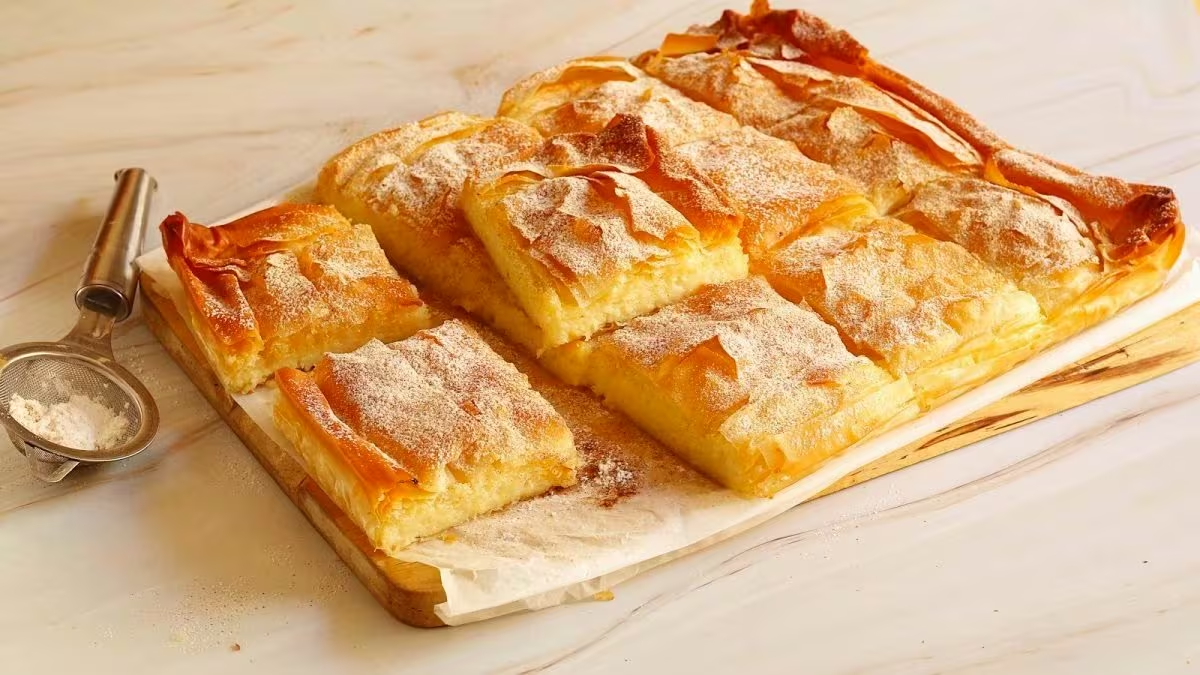
Our next stop on Crete was Heraklion, home to the iconic Lions Square. We walked around, did some final shopping, and got our final gelato fix, which Dr. McLarty had his eyes on. Lions Square is where the locals go to hang out, have coffee, and eat the local pastry—bougatsa.
Our final stop on this trip was the totally unique island of Santorini which lived up to its considerable hype. It offers an incredible volcanic caldera, jaw-dropping cliffside sunsets, and iconic whitewashed villages with blue-domed churches. If Greek islands were US national parks, Santorini would be Yosemite.
As our ship approached the island, I went up to the highest deck and was stunned by what I saw. The Santorini welcome committee are the Caldera Cliffs—dramatic, near-vertical volcanic, 1000-foot cliffs surrounding the main lagoon. As if that weren’t enough, Fira (the capital) is beautifully perched on the caldera rim, just waiting to be explored.

After taking a tender boat to shore, we had three options to get to the top. 1) Hike—that wasn’t happening; 2) Ride a donkey; 3) Take the cable car. Our excursion to the town of Oia included the cable car ride, which was good news for the donkey that would have had to carry me to the top.

After a brief walk through picturesque Fira (known for its vibrant nightlife, clifftop dining and art galleries), we boarded a bus for the even more picturesque village of Oia (pronounced EE-ah), which offers unparalleled sunset views, luxury cave hotels, and scenic windmills. Our first stop was a short walk from the town square to get the iconic Santorini photo with the three blue-domed churches in the background. After perusing several shops, we decided to forego Our Lady of the Perpetual Buffet awaiting us back on the ship and instead indulged in some Santorini pizza, which was outstanding. Santorini, I concluded, would be a great place to live, if you could put up with all the tourists and get by without a Walmart.

Our last stop was the town of Megalochori, a quiet, traditional village located in the southwestern part of Santorini that offers a peaceful escape. Dating back to the 17th century, it is known for its authentic Cycladic architecture, historic mansions, winding cobblestone alleys, and deep-rooted winemaking heritage. Our guide pointed out Vedema, a luxury resort with a 400-year-old winery that Angelina Jolie stayed out (at $840/night) while shooting parts of her film Lara Croft: Tomb Raider – The Cradle of Life.

As we took our tender boat back to the ship in the dark, sparkling fireworks suddenly burst into the sky in front of us. It was a fitting, majestic end to an incredible Walking with Paul tour.

We walked 109 miles over 14 days—that’s over 4 marathons! That breaks down as follows:
May 27 – travel – 8.6 miles
May 28 – Istanbul – 6.5 miles
May 29 – Istanbul – 8.2 miles
May 30 – Bosphorus Cruise – 6.3 miles
May 31 – Philippi & Thessaloniki – 4.2 miles
June 1 – Berea – 8.1 miles
June 2 – Delphi – 6.5 miles
June 3 – Athens – 10.7 miles
June 4 – Corinth – 9 miles
June 5 – Mykonos – 9.2 miles
June 6 – Ephesus – 9 miles
June 7 – Crete & Santorini – 10.3 miles
June 8 – Travel – 5.6 miles
June 9 – Travel – 6.8 miles
Total: 109 miles
Take-away: you get the most out of these trips, and suffer less, if you are in generally good shape.

I hope this 9-part series on our Walking with Paul tour has been useful and encouraging to you. If you ever have the opportunity to tour any part of the Holy Lands, I highly recommend you do so. Kenneth Mills’ Tours is planning a trip to Israel next summer, once again featuring Dr. Bruce McLarty as a speaker. As with this tour, it will fill up fast.
I would also recommend you get a copy of Kenneth Mills’ book Walking with Paul — Greece Travel Guide, which is available on Amazon. It was a valuable resource to me throughout the tour and in preparing these blogs.

I think I speak for everyone on our tour that our experience was faith-affirming. We had a profound opportunity to walk where biblical events occurred. The experience brought Scripture to life, turning abstract stories into tangible experiences that deepened our spiritual faith and historical understanding.
I’m thankful I got to experience this tour, and I’m thankful for the old friends I got to share it with and the new ones I met along the way.

I enjoyed reading all of these so much. Thank you for taking the time to share. What a beautiful world we live in! Love you.
I have truly enjoyed tagging along with y’all on your trip. I probably would’ve enjoyed it more had I been able to actually eat some of that amazing food. I can only imagine what those places were really like during Biblical times. Thank you for taking the time to write this blog. Many of us benefitted from it.
Thank you so much for these. I didn’t take many photos or write many notes. Your posts are my memories. Thanks again.